
Receiver Validation · Logs and Timing Evidence
GNSS PVT Logs for Validation: Epochs, Validity and Output Age
GNSS PVT logs become validation evidence when each decoded output can be traced to its applicable measurement epoch, receiver status, capture time and reference data. Counting messages or plotting coordinates is insufficient: duplicates, delayed records and invalid solutions can all produce plausible-looking traces.
This guide maps two documented receiver interfaces, separates measurement time from arrival time, and builds a ten-epoch ledger covering valid, stale, invalid, missing and unverified data. Use it to define the logging and scoring rules before running a receiver test.
Part of GNSS Simulation 101. For the PVT processing chain, see how GNSS receivers work.
Retain raw records, receiver configuration and capture health
Start with receiver model, firmware, protocol revision, enabled messages and their actual output schedules. A navigation calculation rate does not necessarily equal a message's output rate. Define the expected epochs from the configured output stream and its documented scheduling behavior.
Keep the original bytes alongside decoded data. Record the input interface, collector version, record or byte offsets, checksum result and complete-record capture time. Also retain evidence of buffer overruns, dropped network packets, write failures and clock changes.
Choose the capture boundary explicitly. A timestamp taken when the complete record reaches a host application includes the delays before that point. A network-interface timestamp or first-byte timestamp has a different meaning. Preserve the capture convention and its uncertainty with the data.
Use a monotonic clock for local arrival ordering, with an independently verified mapping to the chosen reference time. Receiver time-validity flags describe receiver time; they do not validate the host clock or the capture path.
Map the actual receiver protocol before defining “valid PVT”
The examples below use NovAtel OEM7 documentation D100402 v6A, September 2026, and u-blox ZED-X20P HPG 2.10, protocol 50.11, interface description R02. Verify the document against the actual DUT. These fields are not a universal GNSS schema.[1][2]
| Meaning | NovAtel OEM7 example | u-blox NAV-PVT example |
|---|---|---|
| Navigation epoch | Header GPS week and seconds; apply message-specific timing semantics. | iTOW: navigation-epoch GPS time of week, in ms. Establish the week separately. |
| Solution validity | BESTPOS sol stat plus the permitted pos type. |
fixType plus flags.gnssFixOK; a 3D type alone does not prove validity. |
| Receiver time quality | Header Time Status, interpreted using the allowed project states. |
validDate, validTime and fullyResolved concern UTC interpretation. |
| Height convention | BESTPOS hgt is MSL height; retain datum and undulation. |
height is ellipsoidal; hMSL is MSL. Both use mm. |
| Reported uncertainty | BESTPOS latitude, longitude and height standard-deviation fields. | hAcc and vAcc: accuracy estimates, in mm. |
| Age-related fields | BESTPOS diff_age/sol_age; BESTVEL latency/age have distinct roles. |
tAcc estimates UTC time accuracy, in ns; it is not transport delay. |
For BESTPOS, SOL_COMPUTED is the documented solution-validity condition, while the solution type needs separate selection. On SPAN-enabled systems, BESTPOS may contain a GNSS/INS solution. Record which solution family the test permits.[1]
In NAV-PVT, UTC validity is separate from fix validity. fullyResolved addresses whole-second ambiguity and cannot, by itself, establish fully solved time. Small reported accuracy estimates also do not establish small measured errors.[2]
Finite coordinates are not a validity test. NovAtel documents that position-timeout handling can set the position type to NONE while retaining the last position values in other fields. A parser that accepts every numeric coordinate can therefore score invalid data as a current fix.[3]
Calculate output age from the applicable epoch
Define the quantity being scored and its time of applicability first. NovAtel documents synchronous BESTPOS timestamps as measurement-time estimates; other log classes have different timestamp semantics.[4] For BESTVEL, the documented velocity epoch is the header time minus the returned latency.[5]
        t_app = documented applicability epoch, mapped to common time

        output age = t_capture_complete − t_app
Worked BESTVEL timing calculation
These decoded values are hypothetical. Assume valid receiver time, verified host-clock mapping and constant velocity. The header time is 100.000 s, the returned velocity latency is 0.050 s, and complete-record capture occurs at 100.030 s on the same time basis.
        t_app,velocity = 100.000 − 0.050 = 99.950 s

        output age = 100.030 − 99.950 = 0.080 s = 80 ms
The 30 ms difference from the header is not the velocity's full output age. BESTVEL's separate age field describes differential age. BESTPOS's age fields should likewise retain their native meanings rather than being relabeled as host output age.[5]
Some BESTVEL sources represent interval-average velocity. Applying the documented latency aligns the time tag; it does not turn the quantity into an instantaneous measurement. Use a compatible reference and the documented averaging behavior for dynamic comparisons.
GPS time, UTC and host-monotonic time require explicit conversion. Retain full week/date context and the applicable leap-second information. u-blox's integration documentation explains why an iTOW value alone is insufficient for reliable absolute time.[6]
If the mapping is unknown or produces an unexplained negative age, flag the interval as unverified. Do not clamp negative values to zero or infer the clock offset by minimizing the DUT's position error.
Build a traceable record before joining it to truth
A project-defined normalized record can contain the fields below. They are analysis fields, not a claim that every receiver transmits these names:
        device · boot/session · logical stream · message type · raw-record reference

        native epoch · applicable epoch · complete-record capture time · clock-map ID

        native status/type · normalized validity · values/units/frame/reference point

        reported uncertainty · checksum result · capture-health evidence
- Validate and decode. Check framing, length and the protocol checksum. Preserve malformed records and decoder failures with their byte references.
- Identify the record. Use device, session, logical stream, message type and verified epoch. Define how copies from multiple ports and revised same-epoch records are handled.
- Resolve time. Establish week/date, time scale, message applicability and clock mapping. Separate clock segments when a restart or mapping discontinuity requires it.
- Apply validity rules. Keep native flags and the rule version. Distinguish position, velocity, time and other channel validity.
- Align the reference. Match the applicable epoch, coordinate frame, height convention and physical reference point. Record any reference interpolation and its uncertainty.
- Classify planned epochs. Apply a fixed association and duplicate policy. Count missing, invalid, stale and unverified outcomes without filling them from another epoch.
NovAtel's ASCII Sequence # counts down within related log sets; it is not a universal increasing packet counter.[7] Preserve your own capture index to reconstruct arrival order.
Separate position and velocity logs are not automatically a co-temporal PVT record. Even matching header tags may require a velocity timing adjustment. Align each quantity using its own semantics before forming a combined result.
Compute horizontal position error in a suitable metric frame, such as local east/north coordinates, after the required datum and point transformations. Receiver-reported uncertainty remains a separate column. See the GNSS accuracy metrics guide for statistical definitions.
Worked ledger: duplicates, out-of-order delivery and gaps
This ten-epoch dataset is invented for auditing practice. It scores only one position stream, not every PVT channel. The configured 10 Hz output has planned epochs from 1000.000 through 1000.900 s in the interval [1000, 1001) s. The times below are elapsed seconds on a verified common clock after native week/date resolution.
A qualified epoch needs the allowed receiver solution type and valid position status, output age from 0 to 100 ms, and independently measured horizontal error no greater than 0.20 m. These limits are hypothetical project choices. Reference geometry, timing and uncertainty are assumed adequate.
Use the first structurally valid complete record for each declared stream/epoch identity. Retain later copies for audit and flag conflicting duplicates. A missing row is finalized only after a predeclared collection deadline and late-arrival grace period. No same-epoch copy may qualify a different planned epoch.
| Planned epoch (s) | Complete capture (s) | Age | Horizontal error | Classification |
|---|---|---|---|---|
| 1000.000 | R1 · 1000.040 | 40 ms | 0.08 m | Qualified |
| 1000.100 | R2 · 1000.140 | 40 ms | 0.07 m | Qualified |
| 1000.200 | R5 · 1000.350 | 150 ms | 0.10 m | Stale |
| 1000.300 | R4 · 1000.340 | 40 ms | 0.09 m | Qualified; arrived before R5 |
| 1000.400 | R6 · 1000.440 | 40 ms | Not scored | Invalid position status |
| 1000.500 | R7 · 1000.540 | 40 ms | 0.45 m | Error limit exceeded |
| 1000.600 | No complete record | Unknown | Unknown | Confirmed missing at the healthy capture boundary |
| 1000.700 | R8 · 1000.740 | 40 ms | 0.06 m | Qualified |
| 1000.800 | Capture coverage unavailable | Unverified | Unknown | Capture unknown; DUT output cannot be determined |
| 1000.900 | R9 · 1000.940 | 40 ms | 0.11 m | Qualified |
Additional raw record R3: an identical-payload copy of epoch 1000.100 arrives at 1000.180 s. It is retained as a duplicate and does not add a qualified epoch. Thus there are nine captured complete records, eight distinct observed epochs and ten planned epochs.
        10 planned epochs = 5 qualified + 4 known nonqualifying + 1 unverified

        Known nonqualifying = 1 stale + 1 invalid + 1 error failure + 1 confirmed missing

        Observed qualification = 5 / 10 = 50%
The unverified epoch stays visible. A rate calculated only over the eight observed epochs would conceal missing and unknown coverage. Resolve the capture failure or rerun the affected interval before making a complete DUT availability claim.
“Confirmed missing” means no complete record was observed at the declared, verified capture boundary within the deadline. It does not by itself identify whether the receiver, transport or another upstream component caused the absence.
Report channel results and unresolved evidence separately
Keep overlapping diagnostic flags, then apply a documented precedence if the report requires mutually exclusive counts. An invalid record can also be late; counting it twice in a partition would overstate the number of failed epochs.
- Capture coverage: raw complete records, distinct epochs, malformed records, duplicates, confirmed gaps and unknown intervals.
- Validity and solution family: per-channel status, accepted types and transitions.
- Freshness: age distribution, stale and unverified counts, capture boundary and clock-map uncertainty.
- Accuracy: same-epoch errors, reference uncertainty and the exact population used for each statistic.
- Reproducibility: native data references, configuration, parser version, mapping rules and scoring-policy version.
Repeated coordinates can be entirely normal for a stationary receiver. Detect duplicate or stale records using identity, applicability time and protocol status, not coordinate equality alone. During an outage, a fused solution can also remain fresh while using older GNSS aiding; distinguish output age from age of the last aiding measurement.
A checksum failure, collector outage or unknown clock mapping is evidence about the test chain. Retain it and state how it limits the conclusion. Ten illustrative epochs cannot establish a receiver's reliability distribution or its full operating envelope.
Connect DUT logs with controlled inputs and reference evidence
A useful bench preserves three related records: the applied GNSS conditions and events, the DUT's native outputs, and the reference/timing evidence used for scoring. Give them common run IDs and independently verify their time relationship.
Define stimulus and capture as separate responsibilities
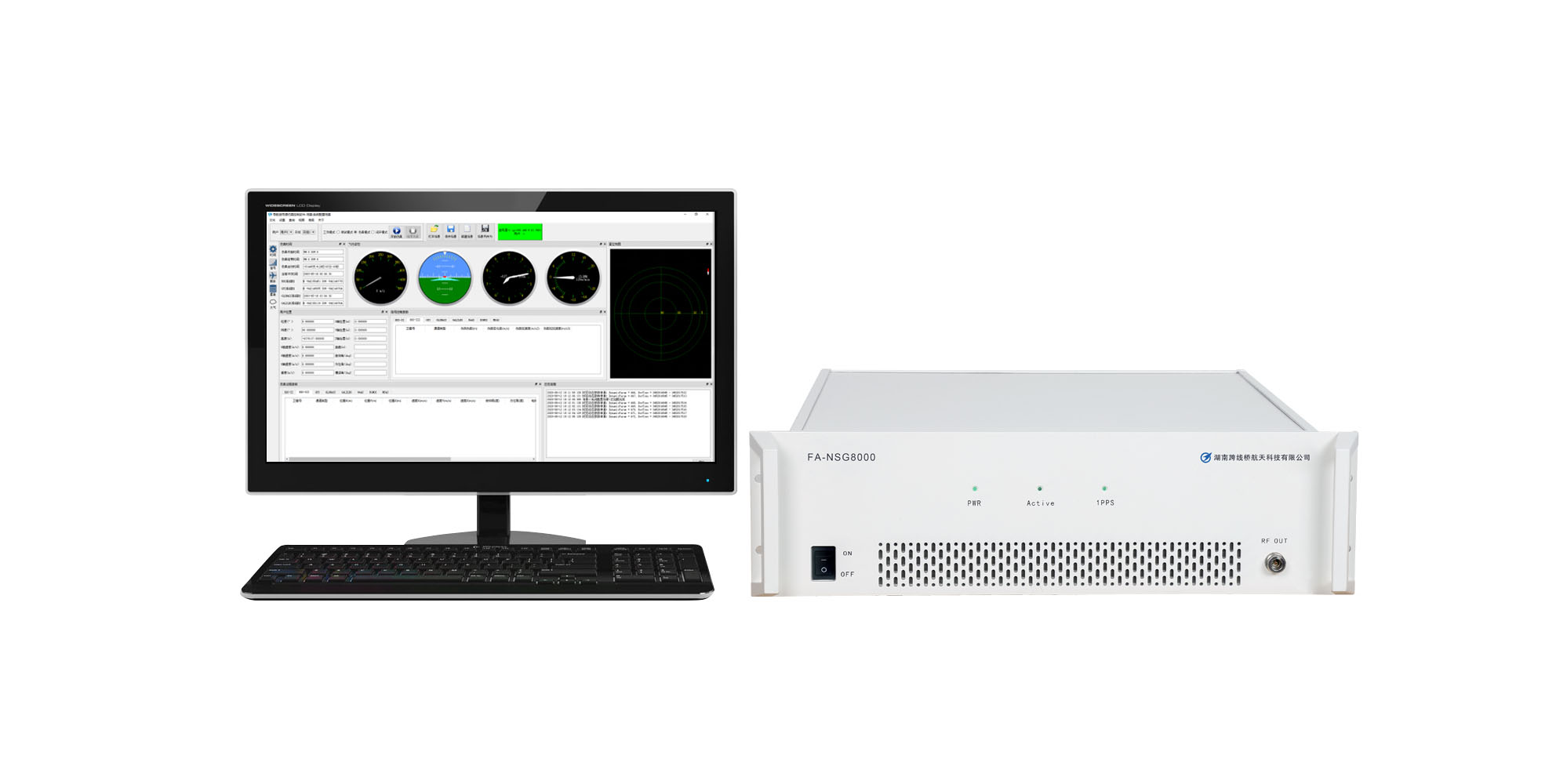
The NSG8000 provides configurable GNSS signal simulation for receiver evaluation. A complete evidence chain also needs the selected DUT logging interface, protocol decoder, clock mapping and analysis rules.[8]
Platform reference image. Logging, export and analysis integration are defined for the project.
Use the receiver validation test plan to set the acceptance requirements, then review integrated GNSS test systems for the signal, timing and capture arrangement.
Define the log-to-evidence chain for your DUT
Share the receiver model and firmware, protocol documentation, a sanitized sample record, required output schedule, capture interface and acceptance limits. These inputs help identify the required stimulus, timing evidence, decoder mapping and result-comparison responsibilities.
GNSS PVT log validation FAQ
Does one PVT log always contain position, velocity and time?
No. A receiver may provide a combined navigation message or separate position and velocity logs. Check the actual fields and align each quantity using its documented time of applicability.
Is receiver solution age the same as output age?
Do not assume so. Preserve the vendor field definition. This guide defines output age as complete-record capture time minus the applicable epoch after both are mapped onto verified common time.
Can a 3D fix flag prove that a position is valid and accurate?
A solution type is only one part of the validity decision. Check the documented status flags and project rules, then compare against an adequate independent reference for measured accuracy.
Should repeated coordinates be deleted as duplicates?
No. Repeated coordinates can describe different valid epochs at a stationary point. Deduplicate using the declared device/session/stream/message/epoch identity and retain the original records.
Can a missing file row be counted as a receiver failure?
Only verified capture coverage can establish an absence at the declared boundary. Buffer loss, parser failure, file truncation or an unknown clock segment may prevent attribution to the receiver.
Can negative output age be treated as zero latency?
No. Investigate time-scale conversion, clock mapping, timestamp semantics and any documented prediction behavior. An unexplained negative age cannot satisfy a verified freshness requirement.
Protocol and technical references
Apply the documentation for the DUT's actual firmware and protocol version. The decoded timing values and normalized ledger above are invented examples, not captured manufacturer records.
- NovAtel OEM7: BESTPOS — position fields, solution status and types.
- u-blox: X20 HPG 2.10 interface description, R02 — NAV-PVT, section 3.14.11.
- NovAtel OEM7: POSTIMEOUT — retained fields after position timeout.
- NovAtel OEM7: Message time stamps — interpretation by log class.
- NovAtel OEM7: BESTVEL — velocity applicability, latency and differential age.
- u-blox: ZED-X20P integration manual, R05 — output validity and navigation time.
- NovAtel OEM7: ASCII message structure, header and sequence field.
- GNSS Simulator: NSG8000 GNSS signal-simulation platform.