
GNSS Receiver Testing · Startup Performance
GNSS TTFF Testing: Cold, Warm and Hot Starts
GNSS TTFF testing measures the elapsed time to a defined first position fix from a reproducible starting condition. A defensible cold-, warm- or hot-start result needs a documented receiver state, a verified timing origin, qualified output and a record of every attempted trial.
This guide provides a receiver-specific preparation example, an execution procedure and a worked result ledger with timeouts. It is intended for receiver developers, OEM integrators and engineers comparing firmware or validating startup requirements.
Part of GNSS Simulation 101. The GNSS metrics guide explains TTFF terminology; the receiver validation test plan covers the wider campaign.
Prepare a Receiver State, Not Just a Start-Mode Label
Cold, warm and hot starts describe different retained-information conditions. A cold-start recipe removes the relevant prior navigation knowledge; a warm start retains selected knowledge but lacks current ephemerides; a hot start retains information that remains usable for the new epoch. The exact preparation depends on the DUT.
Define what happens to time, position, ephemerides, almanacs, oscillator information, predicted orbits and external assistance. A short interruption of the main supply may leave a backup domain powered. A host can also reload assistance after the receiver restarts.
Keep assisted and unaided tests in separate cases. For an assisted case, record the assistance content, age, delivery timing and whether acquisition of that data is inside the measured interval. Manufacturer TTFF examples also use specific fix and test conditions; they are not interchangeable acceptance limits.[1]
Receiver-Specific Example: MAX-M10S with SPG 5.10
The reference profile below applies to u-blox MAX-M10S-00B-01, ROM SPG 5.10, protocol 34.10. It describes documented controls, not measurements performed on this page. Confirm the actual unit identity with UBX-MON-VER and retain its hardware, firmware and configuration records.
For this example, hold UBX-CFG-RST.resetMode = 0x01 constant and vary the navigation backup-memory mask. Reset type and navigation-data clearing are separate choices.[2]
| Profile | navBbrMask | Documented navigation-data action | Additional test preparation |
|---|---|---|---|
| C0: cold | 0xFFFF |
Cold-start navigation BBR clearing set. | Control assistance and automatic state restoration; isolate RF during preparation. |
| W0: warm | 0x0001 |
Clear ephemerides; leave other unselected navigation BBR information. | Seed the required retained state, then document its age and the clearing operation. |
| H0: hot | 0x0000 |
Do not request navigation BBR clearing. | Seed and establish that retained information is appropriate for the new scenario epoch. |
The integration manual states that this controlled software reset clears RAM and reloads configuration. Save the intended configuration appropriately and verify it after restart. Its hardware-reset paths clear BBR and are unsuitable substitutes for this retained-state comparison.[3]
The interface documentation says not to expect an acknowledgement for UBX-CFG-RST. Do not repeatedly restart the DUT because an ACK is absent. Record the transmitted command and verify restart/configuration evidence through the declared procedure.[2]
The cold navigation mask is not a factory-configuration reset and does not stop later host aiding. Audit startup traffic, database restoration and autonomous-assistance settings. Available status readback can support the preparation record, but it does not expose every internal memory item. Mark the state unverified if the required evidence cannot be established.
Keep Retained Data Consistent with the Scenario Epoch
For W0 and H0, acquire the required navigation information from a known source before isolation. Record the seed interval, last accepted fix epoch, retained-data evidence, source location and elapsed isolation time. A hot-start mask cannot make expired or inconsistent ephemerides usable.
In an illustrative warm/hot preparation, isolate RF for 30 seconds after the documented seed condition, perform the selected restart during that interval and reintroduce RF on schedule. The source’s GNSS time continues forward. This 30-second gap is a test choice, not a universal definition of hot start.
Do not rewind the simulator and assume the receiver’s previous cache still represents the same start condition. Either preserve chronological consistency or prepare a fresh compatible state. Record backup-power behavior and any restored assistance, as described for the selected receiver.[3]
Freeze the trial schedule as well as the RF conditions. Navigation-message phase, geometry, cache age and acquisition scheduling can affect startup results. A fixed-epoch regression and a campaign across planned epochs answer different questions. Random waiting alone does not replace state preparation.
Write the Timing Contract Before Running the Test
The worked method uses RF-start qualified TTFF: prepare the receiver while test RF is isolated, establish the declared receiving-ready precondition, then start timing when the intended RF is actually available at the DUT. This excludes earlier boot and configuration time. Establish readiness from declared control/status evidence while RF remains isolated; do not wait for acquisition of the scored signal before starting the timer.
Record these events on a verified common time basis:
- t₀: effective RF presentation at the DUT input, rather than the host’s RF-on command.
- tᶠ: first navigation epoch of the earliest sequence that passes the complete qualification rule.
- tᶜ: navigation epoch completing the required persistence check.
- tʰ: host arrival time of each corresponding message.
Qualified TTFF = tᶠ − t₀
Confirmation time = tᶜ − t₀
Host-visible timing additionally includes message delivery and processing.
For example, let the first qualifying sequence contain epochs at 20, 21 and 22 seconds after RF presentation. If the first and last messages arrive at 20.3 and 22.3 seconds, qualified TTFF is 20 seconds, confirmation takes 22 seconds and the host can finish confirming at 22.3 seconds.
Retain the raw first-fix candidate and confirmation result. If the product requirement starts at power application or a reset request, report that end-to-end metric separately. The receiver’s own UBX-NAV-STATUS.ttff field must not be assumed to implement this custom timing and qualification contract.[2]
Freeze the RF, Fix and Deadline Rules
The numerical settings and results below are hypothetical. The receiver profile uses documented MAX-M10S controls; the example timings are not u-blox specifications, measured receiver performance or simulator guarantees.
| Item | Declared example condition |
|---|---|
| RF and scenario | Eight GPS L1 C/A satellites; −130 dBm per signal at the DUT connector; characterized conducted path, noise condition and timing uncertainty; fixed supply and 25°C environment; versioned scenario and trial-epoch schedule. |
| Receiver state | MAX-M10S-00B-01 / ROM SPG 5.10; selected C0, W0 or H0 recipe verified per attempt; continuous operating mode; required configuration read back after reset. External aiding, autonomous prediction and automatic database restoration disabled for these unaided cases. |
| Fix qualification | 1 Hz current GNSS 3D PVT; UBX-NAV-PVT.fixType = 3 and gnssFixOK = 1; horizontal error ≤ 10 m against independent scenario truth; output age ≤ 1.0 s on the verified clock map. Frame, datum, reference point and truth uncertainty recorded. |
| Persistence check | Three consecutive qualifying 1 Hz epochs spanning 2.0 s. Missing, invalid, duplicate, stale or non-monotonic epochs break the sequence. TTFF is assigned to its first epoch after confirmation. |
| Deadline and coverage | First qualifying epoch must be at or before 60 s. Observe epochs through at least 62 s to confirm a candidate starting at 60 s, with a further 1.0 s message-arrival allowance. Incomplete logging makes the attempt unscorable. |
| Trial accounting | Target ten scored trials per case. Retain every attempt; preserve valid DUT timeouts. Investigate state-unverified and setup-invalid attempts under a declared replacement rule. |
The protocol fix flags are starting filters, not independent accuracy truth. Use the actual solution epoch and status; a receiver’s hAcc estimate does not replace measured error against the reference.[2]
A sequence at 59, 60 and 61 seconds passes with TTFF = 59 seconds. A sequence at 60, 61 and 62 seconds also meets this first-epoch deadline. Stopping the logger at 60 seconds would prevent those decisions. If the requirement instead demands completed confirmation by 60 seconds, define and score that different deadline explicitly.
Execute the Same Preparation for Every Attempt
- Assign an attempt ID before changing state. Load the selected recipe, scenario version and planned epoch; begin control and receiver logging.
- Isolate RF and prepare the start state. For W0/H0, complete the declared seed and retention procedure. For C0, apply the declared clearing and assistance controls.
- Check the preparation evidence. Confirm identity, configuration, reset transmission, host traffic and available navigation-state indicators. Do not use a fix obtained during preparation to satisfy the scored trial.
- Present the declared RF and record t₀. Keep the level, noise, signal set and timing evidence associated with this attempt.
- Evaluate candidate sequences. Preserve the first raw candidate, qualifying epochs, confirmation and message-arrival times. Continue through the complete coverage window.
- Close the attempt with a reasoned status. Archive raw logs and state evidence before preparing the next trial. Do not delete a valid timeout or silently relabel it as setup-invalid. Slow TTFF alone is not evidence of an invalid start.
Use separate case IDs for power levels, signal combinations, assistance modes and start states. Report the sample size and the units tested. Repeated starts on one receiver measure behavior under that campaign; they do not establish fleet-wide reliability.
Worked Results: Keep Timeouts in the Campaign
The following hypothetical ledger covers one C0 case under TTFF-01. It does not combine cold, warm and hot results.
| Attempt | Final status | Qualified TTFF | Evidence note |
|---|---|---|---|
| A01 | SUCCESS | 24 s | Confirmed sequence starts at 24 s. |
| A02 | STATE_UNVERIFIED | Not scored | Assistance-restoration state not established. |
| A03 | SUCCESS | 28 s | Confirmed sequence starts at 28 s. |
| A04 | SUCCESS | 30 s | Confirmed sequence starts at 30 s. |
| A05 | TIMEOUT | > 60 s | No qualifying sequence starts by 60 s; complete confirmation coverage retained. |
| A06 | SUCCESS | 32 s | Confirmed sequence starts at 32 s. |
| A07 | SETUP_INVALID | Not scored | Logger gap prevents a reliable first-fix decision. |
| A08 | SUCCESS | 36 s | Confirmed sequence starts at 36 s. |
| A09 | SUCCESS | 42 s | Confirmed sequence starts at 42 s. |
| A10 | TIMEOUT | > 60 s | Valid input and state; no qualifying start within the deadline. |
| A11 | SUCCESS | 52 s | Confirmed sequence starts at 52 s. |
| A12 | SUCCESS | 59 s | Epochs 59/60/61 s qualify; confirmation completes after 60 s. |
Report 12 attempted, 10 scored, 8 successful by the deadline and 2 valid timeouts, plus the two unscored reasons. The observed success proportion for the scored DUT trials is 8/10 = 80%.
A timeout is not an exact 60-second fix
The two valid timeouts retain “qualified TTFF > 60 s” information. They are right-censored observations for this endpoint, rather than exact values of 60 seconds. NIST describes the fixed-window censoring principle.[4] Missing logs and unverified starts are different problems and remain outside this scored cohort.
Label success-only percentiles explicitly
The eight successful TTFF values are 24, 28, 30, 32, 36, 42, 52 and 59 seconds. Using the declared nearest-rank rule, rank = ceiling(p × N), their success-only P95 is 59 seconds.
For all ten scored trials, the 95th-percentile rank is ten. That rank is not observed within the 60-second window, so the full-cohort P95 cannot be determined from this run. Reporting “P95 = 59 s” for the whole campaign would conceal the timeouts.
Record the percentile algorithm because calculation conventions differ.[5] Do not replace censored records with exact deadline values and calculate an ordinary mean or percentile. Larger reliability claims require a suitable sampling and statistical plan; 80% here is an observed proportion.
Separate GNSS RF Generation from DUT Control and Scoring
A TTFF bench needs controlled RF, receiver-state preparation and timestamped logging. The RF source supplies the scenario; the DUT controller applies and records the receiver-specific procedure; the logger and analysis implement the declared timing and qualification rules.
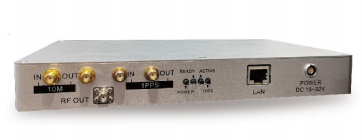
Match the RF source to the campaign
Review the NSG2000 for a compact source configuration, or the NSG8000 for configured multi-constellation and multi-frequency scenarios. Confirm the required satellite/signal set, power definition, epoch control and interfaces.
Product reference image. Receiver-reset automation, state readback and TTFF reporting require separate interface and workflow confirmation.
Use the GNSS signal simulation solution to discuss the bench, the simulator product family to review platforms, and the simulator selection guide for broader configuration decisions.
Define a Repeatable TTFF Test
Share the receiver model and firmware, start-state requirements, signals, DUT input levels, assistance mode, timing origin and fix deadline. We can review the RF configuration and the DUT-control and logging interfaces needed for your campaign.
GNSS TTFF Testing FAQ
Does switching the main power off guarantee a cold start?
No. Backup power, persistent navigation data or host assistance can preserve or restore information. Follow the actual receiver’s preparation procedure and record the resulting evidence.
Can the same reset command test cold, warm and hot starts?
Some protocols separate reset type from navigation-data clearing. The documented MAX-M10S example does so, but its fields and masks are not universal commands for other receivers or firmware.
When should the TTFF timer start?
At the event defined by the requirement: power application, a documented restart event or effective RF availability. The worked method uses RF presentation after preparation. Results using other origins must be labeled separately.
Should a persistence check be included in TTFF?
Declare the rule. This example assigns TTFF to the first epoch of a subsequently confirmed sequence and records confirmation time separately. A deadline for completed confirmation is a different acceptance rule.
Can I remove timeout runs before calculating P95?
You may report a clearly labeled success-only statistic, alongside the complete counts. It must not replace the campaign result. Preserve the deadline and censoring information for valid timeouts.
Why can two hot-start trials give different results?
Retained-data age, time consistency, signal conditions, navigation-message phase and receiver scheduling can differ. Recreate the declared preparation, record the trial epoch and report repeated outcomes.
Technical References
The manufacturer-specific preparation profile is a documented example. Numerical bench conditions, timing examples and result counts on this page are illustrative.
- Safran Navigation & Timing, Basic GNSS Tests: Time to First Fix — controlled start conditions and test-specific fix definitions.
- u-blox, M10 SPG 5.10 Interface Description, UBX-21035062 R03 — UBX-CFG-RST, UBX-NAV-PVT and UBX-NAV-STATUS.
- u-blox, MAX-M10S Integration Manual, UBX-20053088 R05, sections 3.4 and 3.12 — reset behavior, retained information and assistance.
- NIST/SEMATECH, Engineering Statistics Handbook: Censoring — fixed observation windows and right-censored records.
- NIST/SEMATECH, Engineering Statistics Handbook: Percentiles — order statistics and calculation conventions.