GNSS Signal Simulator
Systems
Compare GNSS and GPS signal simulator systems for multi-constellation receiver R&D, production testing, real-time HIL, automated terminal evaluation, and BeiDou RDSS closed-loop workflows. Review signal coverage, trajectory control, form factor, and reporting capabilities to select the right model.
Compare GNSS & GPS Signal Simulator Models
Compare four GNSS signal simulator and test systems by receiver workflow, signal coverage, scenario control, real-time integration, platform format, and reporting capability. Use the table below to identify the appropriate system before reviewing model-level specifications.
| Model | Best For | Signal Coverage | Scenario / Control | Platform | Reporting |
|---|---|---|---|---|---|
| NSG8000 Advanced R&D & HIL | Advanced receiver R&D, multi-frequency validation, multipath testing, and real-time HIL integration |
BDS / GPS / GLONASS / Galileo
Extensible signal configurations |
Trajectory file import, real-time injection, propagation modeling, and external timing synchronization | Rack-mount | Engineering data and standard interface output |
| NSG2000 Portable Receiver R&D | Receiver R&D, debugging, production support, and portable laboratory testing | BDS / GPS / GLONASS civil signals | Trajectory file import, online injection, propagation modeling, and optional closed-loop workflows | Portable / bench-top | Engineering data and standard interface output |
| NPT4000 Automated Evaluation | Automated terminal evaluation, production acceptance, repeatable workflows, and device record management | BDS-B1/B3, GPS-L1, GLONASS-L1 + RDSS | Preset test workflows, editable scenarios, and external trajectory file input | Portable evaluator | Automatic reports + device archives |
| SGS8000 BeiDou RDSS | BeiDou RDSS closed-loop verification, short-message terminal testing, and system integration | BD1 / BD2 / BD3 RDSS | Outbound RDSS signal simulation with inbound signal receiving and response processing | Dedicated RDSS system | Automated test reports |
Signal, frequency, interface, and real-time integration configurations vary by model and licensed options. Confirm the final configuration against your receiver and test workflow requirements.
NSG8000 — Advanced Multi-Constellation R&D & HIL
NSG8000 supports BDS, GPS, GLONASS, and Galileo signal simulation with additional constellation options. It can reproduce static, kinematic, high-dynamic, atmospheric, and multipath conditions, accept trajectory files or external motion data, and synchronize with external timing references for integrated laboratory test systems.
- Configurable BDS, GPS, GLONASS, and Galileo signals with multi-frequency support and optional constellation extensions.
- Trajectory file import and real-time external motion injection for open-loop and hardware-in-the-loop receiver testing.
- Ionosphere, troposphere, multipath, user-dynamics, and pseudorange models for repeatable complex-scenario validation.
- External timing synchronization, standard data interfaces, and configurable multi-RF output for integrated test architectures.
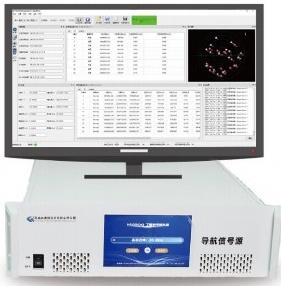
| System Type | Multi-constellation, multi-frequency GNSS signal simulator |
| Constellations | BDS / GPS / GLONASS / Galileo, with optional extensions |
| Signal Coverage | BDS B1/B2/B3; GPS L1/L2/L5; GLONASS L1/L2; Galileo E1/E5a/E5b |
| Signal Channels | Up to 70 simultaneous channels |
| Trajectory Control | File import + real-time external motion injection |
| HIL Performance | 1 Hz–1 kHz update rate; ≤10 ms end-to-end latency |
| RF Configuration | Configurable, with up to 4 RF outputs |
| Scenario Models | Ionosphere, troposphere, multipath, and user dynamics |
| Timing Sync | 10 MHz and 1PPS reference I/O |
| Form Factor | Standard 3U, 19-inch rack-mount |
Signal licenses, RF output quantity, HIL interfaces, timing options, and integration requirements are configured according to the selected test architecture.
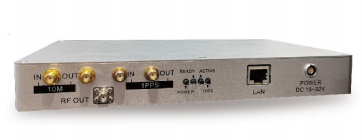
| System Type | Portable GNSS signal simulator |
| GNSS Coverage | BDS / GPS / GLONASS civil signals |
| Frequency Capacity | Up to 3 configured GNSS frequency points |
| Configuration | Signal and frequency-point configuration selected before delivery; not expandable after purchase |
| Trajectory Control | File import + online trajectory injection |
| Scenario Models | Multipath, ionosphere, troposphere, and user dynamics |
| Optional Functions | Real-time closed-loop and differential positioning simulation |
| Control Platform | External control computer required; not included by default |
| Output | RF output and standard engineering data interfaces |
| Form Factor | Portable / bench-top |
Frequency points and signal types are different configuration concepts. GPS L1 may refer to L1 C/A, L1C, or L1P. Unless otherwise confirmed, a requirement stated only as “GPS L1” is configured as GPS L1 C/A.
NSG2000 — Portable Receiver R&D & Production Testing
NSG2000 is configured before delivery for selected BDS, GPS, and GLONASS civil signals, with support for up to three GNSS frequency points. It provides repeatable trajectory workflows, online injection, propagation modeling, and engineering data output in a compact bench-top platform. The selected frequency-point configuration is fixed and requires an external computer to run the simulation software.
- Selected civil GNSS signal configurations across BDS, GPS, and GLONASS, supporting up to three configured frequency points.
- Trajectory file import and online injection for repeatable static, dynamic, and field-to-lab receiver test scenarios.
- Multipath, ionosphere, troposphere, user-dynamics, and pseudorange modeling for controlled engineering validation.
- Optional real-time closed-loop and differential positioning simulation for focused HIL, RTK, and DGNSS workflows.
NPT4000 — Automated Terminal Evaluation & Reporting
NPT4000 combines GNSS and RDSS test stimuli with preset or editable evaluation profiles. It executes configured test sequences, supports external trajectory files, generates structured reports, and stores device configurations and result history for engineering review and production acceptance workflows.
- GNSS terminal test stimulation across BDS-B1/B3, GPS-L1, and GLONASS-L1, with RDSS outbound simulation and inbound receiving.
- One-click workflows using preset or editable profiles for consistent test execution without rebuilding each sequence.
- Static to high-dynamic scenarios and external trajectory-file import for controlled terminal evaluation paths.
- Automatic report generation, major-module fault localization, and device archives containing configurations, results, and test history.
| System Type | Portable GNSS navigation terminal evaluation tester |
| Primary Use | Automated terminal evaluation, production acceptance, and managed test records |
| GNSS Signals | BDS-B1/B3, GPS-L1, and GLONASS-L1 |
| RDSS Support | Outbound simulation + inbound receiving |
| Test Workflow | One-click execution with preset and editable profiles |
| Trajectory | Static to high-dynamic scenarios + external trajectory import |
| Diagnostics | Fault localization to the major-module level |
| Report Output | Automatic structured evaluation reports |
| Archive Management | Device configurations, results, and test history |
| Form Factor | Portable evaluation platform |
Available test profiles, report formats, GNSS/RDSS configurations, and evaluation sequences should be confirmed against the target terminal and acceptance workflow.
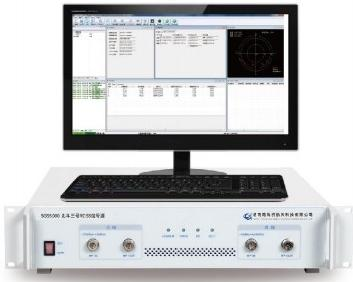
External GNSS source synchronization is configuration-dependent. The external source supplies RNSS signals; SGS8000 remains a dedicated RDSS closed-loop test platform.
SGS8000 — BeiDou RDSS Closed-Loop Testing
Choose SGS8000 when your program requires BD1, BD2 or BD3 RDSS closed-loop verification, including outbound signal generation and inbound terminal response processing. It is a dedicated RDSS test system rather than a general multi-constellation GNSS receiver simulator.
SGS8000 supports controlled testing of BeiDou short-message terminals, emergency search-and-rescue workflows and RDSS communication services. It can generate outbound RDSS signals, receive and process terminal responses, produce structured test reports, and synchronize with an external GNSS signal source for combined RNSS and RDSS testing when configured.
Core SGS8000 Capabilities
- BD1, BD2 and BD3 outbound RDSS simulation with inbound terminal response receiving
- Inbound demodulation, pseudorange calculation, received-power analysis and Doppler estimation
- Short-message, emergency search-and-rescue and communications service validation
- Automated report output and external GNSS source synchronization for combined RNSS and RDSS setups
GNSS Signal Simulation Workflows
Apply GNSS simulator systems to controlled receiver testing, real-time hardware-in-the-loop integration, and application-specific test architectures built around the DUT, required signals, interfaces, RF path, and validation objectives.
Controlled GNSS Signal Simulation
Generate defined and repeatable GNSS RF conditions for receiver development, acquisition and tracking evaluation, dynamic trajectory testing, regression comparison, and project-defined laboratory validation using NSG8000 or NSG2000 systems.
Explore WorkflowReal-Time GNSS HIL Testing
Convert real-time position, velocity, acceleration, and project-defined motion-state data from an external HIL platform into synchronized GNSS RF for closed-loop receiver and navigation-system testing with NSG8000.
Explore WorkflowIntegrated GNSS Test Systems
Combine GNSS signal generation with the required reception, monitoring, recording, timing, control, and customer equipment in one project-specific system architecture with clearly defined platform roles and interfaces.
Explore WorkflowGNSS Signal Simulator FAQs
Understand how GNSS simulator systems are configured for receiver testing, signal validation, real-time HIL integration, controlled scenario reproduction, and authorized resilience evaluation.
What is a GNSS signal simulator used for?
A GNSS signal simulator generates controlled and repeatable satellite-navigation RF signals for testing receivers, antennas, positioning systems, timing equipment, and navigation algorithms in a laboratory environment.
Engineers can use identical defined conditions to evaluate acquisition, tracking, positioning, timing, dynamic response, regression performance, and system behavior without depending entirely on changing live-sky conditions.
Which GNSS constellations and frequencies can the systems simulate?
Depending on the selected model and licensed configuration, the systems can support signals from GPS, BDS, GLONASS, Galileo, and other configured satellite-navigation systems.
Exact signal types and frequencies must be confirmed during configuration. For example, “GPS L1” may refer to L1 C/A, L1C, or L1P, so the required signal type should be specified rather than providing only the general frequency-band name.
How do I choose between NSG8000, NSG2000, NPT4000, and SGS8000?
- NSG8000 is designed for advanced, expandable multi-constellation simulation, complex trajectories, and real-time HIL integration.
- NSG2000 is a compact fixed-configuration simulator for receiver R&D, production support, and controlled civil-signal testing.
- NPT4000 supports automated terminal evaluation, structured test execution, and report generation.
- SGS8000 is a dedicated BeiDou RDSS closed-loop system for outbound signal simulation and inbound terminal-response processing.
Can a GNSS simulator integrate with a real-time HIL platform?
Yes. When the appropriate HIL option and interface are configured, NSG8000 can receive real-time position, velocity, acceleration, and project-defined motion-state data from an external HIL platform and convert that data into synchronized GNSS RF.
The protocol, input fields, units, coordinate frame, update rate, latency target, timing source, and RF-output requirements should be reviewed before configuration. See the GNSS HIL testing workflow for the complete integration path.
Can I test multipath, signal blockage, and urban canyon conditions?
Yes. A configured GNSS simulation system can create repeatable scenarios involving multipath, signal attenuation, obstruction, satellite visibility changes, and degraded sky-view conditions.
The available scenario functions depend on the simulator model, software options, signal configuration, and required propagation environment.
Can the systems support spoofing and interference resilience testing?
Selected systems can support controlled spoofing-awareness and interference-resilience workflows when the necessary software, RF configuration, and authorization requirements are in place.
These tests must be conducted in an authorized and properly controlled laboratory environment. Projects requiring dedicated spoofing or interference generation may also require products from the separate spoofing and interference test family.
What is the difference between GNSS simulation and record-and-replay testing?
GNSS simulation creates a designed RF environment with controlled satellite signals, trajectories, and test conditions. Recording and playback captures a real field RF environment and reproduces that same recorded event in the laboratory.
Simulation is suitable for creating controlled conditions that may not exist in the field, while GNSS signal recording and playback is useful for reproducing actual field events, comparing receivers, and repeating regression tests against identical RF data.
What information is required to configure a GNSS simulator?
To recommend the correct system and signal configuration, provide:
- The receiver, terminal, or navigation system being tested
- Required constellations, frequencies, and exact signal types
- Number of required RF outputs and RF connection method
- Static, dynamic, HIL, timing, or production-test objectives
- Required trajectories, scenarios, and propagation conditions
- External interfaces, input fields, and update rates
- Timing-reference and synchronization requirements
- Expected measurements, reports, and acceptance criteria
Discuss Your GNSS Test Requirements
Share your receiver or navigation-system type, required GNSS signals, test scenarios, and integration constraints. Our engineering team will review the requirements and recommend the appropriate simulator model, signal configuration, software options, and implementation path.