
ASG8000 GNSS Spoofing & Interference Test System
Controlled RF threat scenarios for GNSS receiver resilience validation
ASG8000 is a controlled RF threat test platform for evaluating GNSS receiver resilience, spoofing detection, interference response, and anti-jamming performance under repeatable laboratory scenarios.
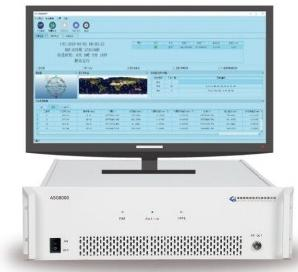
A full-featured spoofing source for authorized receiver resilience testing.
The system helps engineering teams reproduce spoofing, meaconing, replay, and signal-degradation conditions in controlled environments so receiver tracking, alarms, mitigation behavior, and recovery can be evaluated safely and repeatedly.
ASG8000 is not a general GNSS simulator, not a portable compact simulator, and not a recording or monitoring product. Its role is navigation security validation through authorized RF threat scenario generation.
Threat scenario generation
Generate controlled spoofing scenarios for receiver anti-spoofing and navigation security tests.
Closed-loop testing
Support external command control for closed-loop and integrated test workflows.
Timing coordination
Provide 10 MHz, 1PPS, and network timing outputs for multi-instrument lab coordination.
System integration
Integrate through API or control interfaces into larger test, protection, or validation systems.
Product Gallery
ASG8000 rackmount GNSS spoofing signal source views, including front, side, rear panel, and PC connection setup for engineering evaluation.


Controlled RF threat scenarios for repeatable receiver evaluation.
ASG8000 should be described with careful, authorized-use language: controlled spoofing signal generation, repeatable receiver response evaluation, and integration into lab-based navigation security workflows.
Spoofing scenario generation
Supports replay, generative spoofing, and meaconing scenario generation for anti-spoofing feature verification.
Live ephemeris workflow
Collects live ephemeris and generates synchronized spoofing signals in authorized laboratory environments.
External command control
Receives external control commands to support closed-loop test workflows and larger system integration.
Timing synchronization
Provides 10 MHz, 1PPS, and network timing outputs for coordinated multi-instrument test setups.
Receiver behavior assessment
Supports observation of receiver tracking, loss-of-lock, alarm, mitigation, reacquisition, and recovery behavior.
Navigation security validation
Supports lab-based vulnerability assessment for aerospace, UAV, autonomous, receiver R&D, and critical infrastructure test programs.
Specification summary based on ASG8000 test configuration.
The fields below summarize the system role, supported threat scenario types, control interfaces, synchronization outputs, and deployment notes. Numeric RF values should be confirmed against the final test configuration.
System Profile
Full-featured GNSS spoofing source for controlled resilience testing.
Threat Scenario Support
Supported scenario language for controlled spoofing and resilience validation workflows.
Control and Synchronization
Integration features for laboratory and system-level test benches.
Deployment Notes
Final configuration should be confirmed against the test objective.
Where ASG8000 fits in navigation security programs.
ASG8000 is intended for authorized laboratory resilience testing where controlled spoofing or combined threat scenarios must be repeatable and measurable.
Receiver anti-spoofing validation
Evaluate spoofing detection and mitigation behavior under controlled replay, generative, or meaconing scenarios.
Anti-jamming evaluation
Coordinate with interference test workflows to understand receiver behavior under degraded signal conditions.
UAV navigation resilience
Assess navigation robustness for unmanned platforms in repeatable lab-based threat scenarios.
Autonomous system robustness
Validate positioning behavior for autonomous vehicle and robotic navigation stacks under controlled RF threats.
Aerospace and defense testing
Support vulnerability assessment workflows for mission-critical GNSS receivers and platforms.
Critical infrastructure protection
Evaluate timing and positioning protection strategies in authorized, shielded, or controlled environments.
Receiver manufacturer R&D
Compare receiver firmware, antenna, algorithm, and configuration changes under repeatable threat conditions.
Research lab testing
Support navigation security research, spoofing detection algorithm validation, and controlled receiver behavior studies.
A restrained workflow for controlled RF threat testing.
The page keeps the test process engineering-oriented: define the receiver and threat model, execute an authorized scenario, observe receiver behavior, and document the result.
Define receiver
Confirm target receiver type, constellation, frequency, RF connection, and navigation security objective.
Configure scenario
Select spoofing, meaconing, replay, signal degradation, or combined threat conditions.
Execute RF test
Run the controlled threat scenario in an authorized laboratory or shielded test environment.
Observe response
Track receiver lock, alarms, mitigation, reacquisition, recovery, and position or timing behavior.
Compare variants
Compare firmware, antenna, algorithm, or receiver configuration changes under identical conditions.
Document results
Record results for engineering validation, vulnerability assessment, or program review.
Final scope depends on the required threat model.
Use ASG8000 language carefully. It is a controlled laboratory test instrument for authorized validation, not an operational deployment product and not a generic GNSS signal simulator.
Signal requirements
Constellation, frequency, spoofing type, and any required interference test coordination.
RF interface
Connection method, shielded setup, lab routing, and receiver input constraints.
Synchronization
10 MHz, 1PPS, network timing, and other instruments that must remain coordinated.
Test objective
Detection, mitigation, recovery, alarm validation, comparative firmware testing, or system acceptance.
Compare adjacent GNSS test workflows.
Use this section to guide users from ASG8000 into adjacent GNSS testing workflows, including spoofing and interference testing, signal simulation, recording and replay, and reception monitoring.
Spoofing & Interference Test
Parent product family for ASG8000, ASG2000, and JSG8000 resilience testing systems.
View FamilyGNSS Signal Simulation
Use NSG and related systems when the task is controlled GNSS signal simulation rather than threat scenario generation.
Compare SimulatorsSignal Recording & Replay
Use recording and replay workflows when authentic field RF environments must be captured and repeated in the lab.
View FamilyReception & Monitoring
Use monitoring systems for signal quality assessment, anomaly detection, and operating environment observation.
View FamilyPlanning a controlled GNSS resilience test campaign?
Share the target receiver type, required constellation and frequency, spoofing scenario, interference or jamming scenario, RF connection requirements, test objective, and lab or field integration environment.