
JSG8000 Navigation Interference Source
Generate controlled GNSS and RDSS S-band interference signals for satellite navigation receiver anti-jamming performance testing, R&D validation, acceptance verification, and troubleshooting workflows.
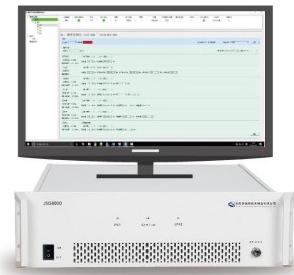
For authorized laboratory testing, receiver anti-jamming verification, R&D validation, and controlled training environments only. Operation of RF interference equipment must comply with applicable spectrum regulations, test-site controls, and internal governance requirements. Confirm legal suitability and operating constraints before procurement or use.
Controlled interference source for receiver anti-jamming validation.
JSG8000 series navigation interference sources are designed for anti-jamming functional and performance testing of satellite navigation receivers. The system can transmit multiple types of interference signals across GNSS navigation frequency points and RDSS S-band interference scenarios.
Each device supports controlled channel configurations for receiver R&D, validation, acceptance testing, and troubleshooting workflows. JSG8000 fits inside the GNSS Spoofing & Interference Test product family as the dedicated interference source, distinct from ASG spoofing systems and distinct from standard GNSS signal simulators.
Anti-Jamming Test
Generate controlled interference excitation for receiver robustness evaluation.
GNSS + RDSS
Covers GNSS navigation frequency points and RDSS S-band interference testing.
Lab Validation
Supports R&D testing, acceptance verification, and troubleshooting.
1 or 3 Channels
JSG8140 provides one channel; JSG8340 provides three independent RF channels.
Interference signal generation for controlled receiver test campaigns.
Frequency Coverage
- Supports interference signal generation for GNSS navigation frequency points.
- Supports RDSS outbound signal frequency interference.
Interference Signal Types
- Single-tone and single-tone sweep interference.
- White noise, amplitude modulation, and frequency modulation interference.
- Spread-spectrum code and sawtooth interference.
Bandwidth and Pulse Control
- Pulse, narrowband, and wideband interference.
- Real-time adjustable bandwidth.
- Real-time adjustable pulse frequency and duty cycle.
Test Synchronization
- Supports synchronous triggering for controlled receiver test execution.
- Designed for repeatable laboratory validation workflows.
JSG8000 Series Variants
Select the variant by required independent RF channel count and the complexity of the receiver anti-jamming validation workflow.
| Variant | RF Channel Count | Best Fit |
|---|---|---|
| JSG8140 | 1 independent RF channel | Single-channel receiver anti-jamming validation |
| JSG8340 | 3 independent RF channels | Multi-channel receiver anti-jamming validation and more complex test excitation workflows |
JSG8000 Technical Specifications
Technical values are presented for engineering evaluation and configuration discussion. Final configuration should match the receiver bands, RF connection method, and authorized laboratory setup.
| Product Type | Navigation Interference Source |
| Product Series | JSG8000 |
| RF Channel Count |
JSG8140: 1 independent RF channel JSG8340: 3 independent RF channels |
| Supported Interference Frequency Bands |
Each channel simultaneously supports: B1: 1550–1610 MHz B2: 1151–1231 MHz B3: 1240–1280 MHz S: 2481–2501 MHz |
| Constant-Envelope Interference Output Power Range | -90 dBm to 10 dBm |
| Non-Constant-Envelope Interference Output Power Range | -110 dBm to -30 dBm average power |
| Power Step | ≤ 0.5 dB |
| Power Accuracy | ± 1 dB within 25 °C ± 2 °C temperature range |
| Power Stability | ≤ 1 dB |
| In-Band Flatness | ≤ 3 dB |
| Harmonic Power | ≤ -45 dBc |
| Spurious Power | ≤ -50 dBc |
| Real-Time Interference Bandwidth |
B1: ≥ 60 MHz, in-band fluctuation < 3 dB within 25 °C ± 2 °C B2: ≥ 80 MHz, in-band fluctuation < 3 dB within 25 °C ± 2 °C B3: ≥ 40 MHz, in-band fluctuation < 3 dB within 25 °C ± 2 °C S: ≥ 20 MHz, in-band fluctuation < 3 dB within 25 °C ± 2 °C |
| Power Input | 196–245 VAC |
| Frequency | 50–60 Hz |
| Power Consumption | ≤ 100 W |
| Form Factor | Standard 3U chassis |
| Weight | ≤ 14.5 kg |
| RF Output | N(F) |
| Reference 1PPS Pulse Signal | BNC(F) |
| Reference 10 MHz Clock Signal | BNC(F) |
| Control Interface | RJ45 |
Receiver validation scenarios for controlled interference testing.
Anti-Jamming Function Verification
Validate receiver anti-jamming functions under controlled signal conditions.
Receiver Acceptance Verification
Support acceptance testing with repeatable interference signal excitation.
Receiver R&D Testing
Evaluate receiver behavior during development and engineering regression tests.
Fault Investigation
Reproduce controlled interference conditions for troubleshooting and fault localization.
Controlled Test Excitation
Generate defined interference stimulus for receiver response measurement.
Receiver Performance Testing
Support GNSS and RDSS receiver performance testing under interference conditions.
Lab Receiver Validation
Run laboratory-based navigation receiver validation in governed test environments.
System-Level Evaluation
Support system-level anti-jamming evaluation for integrated receiver platforms.
A restrained laboratory workflow for receiver anti-jamming validation.
Use JSG8000 as part of an authorized, controlled test bench where receiver behavior, timing, and performance response can be measured under governed laboratory conditions.
Define Objective
Define the receiver anti-jamming test objective and measured behavior.
Select Band
Select the GNSS or RDSS frequency band required for the laboratory test.
Configure Signal
Configure interference signal type and power range within authorized test limits.
Synchronize Timing
Apply synchronous trigger or reference timing when required by the test bench.
Run Validation
Run controlled receiver anti-jamming validation in the approved setup.
Record Findings
Record receiver behavior, performance response, and troubleshooting findings.
Information to confirm before selecting a JSG8000 configuration.
Receiver Type
Confirm the target receiver type and anti-jamming metrics.
Frequency Bands
Define required GNSS or RDSS bands for test coverage.
Channel Count
Select JSG8140 or JSG8340 based on independent RF channel needs.
Signal Types
Confirm required interference modes and parameter adjustment needs.
Power Range
Define output power range and validation limits for the test plan.
Reference Timing
Confirm 1PPS, 10 MHz, or synchronous trigger requirements.
RF Output
Confirm RF output connection and receiver test-bench wiring.
Control Interface
Confirm RJ45 control and laboratory integration requirements.
Lab Environment
Define shielded, conducted, or otherwise authorized test environment constraints.
Compliance
Confirm authorization, spectrum controls, and internal governance requirements.
Place JSG8000 in the correct test family.
Spoofing & Interference Test
Parent product family for authorized receiver resilience and anti-jamming validation workflows.
View FamilyGNSS Signal Simulation
Controlled GNSS signal generation for nominal and scenario-based receiver validation, not a navigation interference source.
View FamilyProducts Page
Browse the broader product portfolio and compare adjacent product families.
View ProductsNeed a controlled interference source for receiver anti-jamming testing?
Send your target receiver type, required GNSS or RDSS bands, channel count, interference signal types, power range, reference timing needs, and laboratory test environment. Our engineering team can help confirm the appropriate JSG8000 configuration.